
The First 30 Days as a Procurement Head - What to Fix Before It's Too Late
By Anupam Aggrwal · 23 March 2026
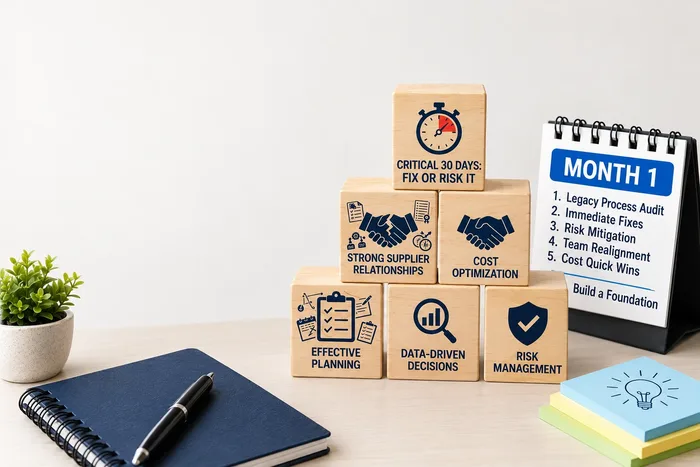
When a new procurement head joins an organization, the first few weeks are critical. What you observe and prioritize during this time shapes your impact for the next few years. In my experience working with mid sized manufacturing, EPC, construction, and service companies, most procurement challenges are not hidden. They are visible if you know where to look.
The real question is not what to change. It is where to start. Over time, I have found that a simple adaptation of the McKinsey 7S framework works well in procurement. Not as a framework to study, but as a practical checklist to assess how procurement actually functions on the ground.
Here are 7-things every procurement head should check upon joining.
1. Strategy
Start with clarity on what procurement is expected to deliver. Is the focus only on cost savings, or does it also include risk management, supplier development, and business continuity? Take a 360-degree view - from the CEO or CFO you report to, all the way down to your team. Look for alignment with the broader business mission.
In many organizations, procurement operates without a clearly defined strategy. Teams react to demand instead of driving value.
This gives you your first action area: align procurement goals with business priorities early, as this sets the direction for everything else.
2. Structure
Look at how the team is organized. Are roles clearly defined, or do responsibilities overlap? Identify business-critical functions and who is handling them. For example, is the procurement team organized functionally or by category? Do roles align with the skill sets they demand? Often, the busiest person on the team is also the most stretched and that is rarely a coincidence.
In mid-sized organizations, it is common to see the same person handling sourcing, negotiations, and operations. This creates bottlenecks.
This is secord actioan area: Even small changes in role clarity can significantly improve speed and accountability.
3. Systems
This is where most inefficiencies exist. Are processes managed through emails and spreadsheets, or is there a structured system in place? Review investments and annual costs in existing systems, along with their adoption rates. An effective system should be widely used, with all critical data and information accessible to you without depending on anyone else. No critical data, approvals, or decisions should be living in someone's inbox.
If RFQs, supplier comparisons, approvals, and negotiations are scattered across tools, visibility is lost and decision-making slows down.
This gives us the third action area: a simple and structured procurement platform can bring clarity without heavy ERP changes.
4. Processes
Map the actual procurement flow from requisition to payment. Do not rely solely on documented SOPs, observe how work actually gets done and check for exceptions. Review any past audits with a focus on non-conformances and action areas.
Look for delays in RFQs, supplier payables, repeated follow-ups with suppliers, and approval bottlenecks. Where possible, see if are abilities to measure the cycle times of key processes.
This gives you the fourth action area: most process gaps are simple to fix but have a large impact on cycle time and cost.
5. Skills
Assess the capability of your team - not just in operations, but in supplier negotiation, cost understanding, and decision-making. A quick way to gauge this is to review last year's performance appraisals and KPIs. Look for alignment between roles and KPIs, achievement levels, and appraiser comments.
This gives you the fifth action area: many teams are strong in coordination but weak in structured negotiation. This directly impacts pricing and contract quality. Focus on building capability where it matters most.
6. Style
Leadership style plays a significant role in procurement effectiveness. Is the team proactive or reactive? Are decisions data-driven or based on urgency? As the new procurement head, this is largely within your control and it is always a good idea to meet a few key suppliers in the initial days to establish your presence and set the tone.
Procurement heads who bring structure and discipline into everyday work see faster improvements.
This sixth area is a soft action area, but an important one: consistency in approach builds confidence within the team and with suppliers.
7. Shared Values
Finally, look at what the team truly values. Is it speed, compliance, cost, or simply convenience? In many organizations, convenience quietly drives procurement decisions. Single-source suppliers, quick phone calls, and informal processes may feel efficient in the moment – but they gradually erode competitiveness, increase risk, and reduce accountability over time.
As a procurement head, shaping shared values is one of your most important and lasting contributions. A team that values transparency, fairness, and structured decision-making will consistently outperform one that prioritizes comfort and familiarity.
This is the seventh and most enduring action area: align your team around transparency, data-driven decisions, and a culture of continuous improvement.
This will not happen overnight – but every process you structure, every decision you document, and every standard you set moves the organization in the right direction.
Common Mistakes to Avoid
- One common mistake is trying to fix everything at once. This creates confusion and slows down progress.
- Another mistake is over relying on consultants or complex systems before understanding internal gaps.
- Many leaders also underestimate the impact of simple process improvements. Small changes in RFQ structure or approval clarity can deliver quick results.
- Ignoring supplier behavior is another gap. Procurement is not just internal. It is equally about how suppliers respond to your process.
What Good Looks Like
- When these areas are addressed, procurement starts to operate very differently.
- RFQs move faster and are more structured. Supplier responses improve because expectations are clear. Negotiations become more data driven.
- Approvals are quicker because roles are defined. Teams spend less time coordinating and more time making decisions.
- Most importantly, procurement starts contributing directly to profitability, risk reduction, and business agility.
- Where Technology Helps
Once clarity is established across strategy, structure, and processes, technology becomes an enabler.
At procurEngine, we have seen that procurement teams do not need heavy ERP changes or long implementations. What they need is a simple, structured layer that brings RFQs, supplier management, negotiations, and approvals into one place.
This helps teams move from emails and spreadsheets to a more disciplined and visible way of working, without adding complexity.
Questions about this article.
What framework does this approach adapt for procurement?
What is the biggest systems red flag to look for?
What is the most common mistake new procurement heads make?
Why does “shared values” matter as much as process?
About the Author
Anupam Aggrwal has spent more than 25 years handling negotiations and helping organizations improve procurement performance through process transformation, digitalization, and strategic sourcing. He also gives guest lectures to supply chain students at Mays Business School at Texas A&M University and the Eli Broad Graduate School of Management at Michigan State University.