
How to Transform Your Supplier Negotiation Strategy Using the Kraljic Matrix
By Anupam Aggrwal · 1 April 2026
One of the most common questions I hear from procurement leaders is deceptively simple. How do we define the right negotiation strategy for each category of spend? Should the same approach apply across all categories, or does each one need something different?
Many teams default to a basic ABC classification, popularly known as Pareto Principle, focusing effort on the top 20 percent of spend that drives 80 percent of value. It is a reasonable starting point. But it only tells you how much you are spending. It does not tell you how strategically you should manage that spend.
There is a better way to think about this. And it has been around for decades. The Kraljic Matrix is one of the most practical frameworks for spend classification in procurement. Yet in most organizations, it remains limited to presentations and strategy discussions. It is talked about often but rarely used as a day-to-day decision-making tool.
When Peter Kraljic introduced this concept in 1983, he changed how organizations think about procurement. Even today, the idea remains highly relevant. The challenge is not the framework. It is how we apply it.
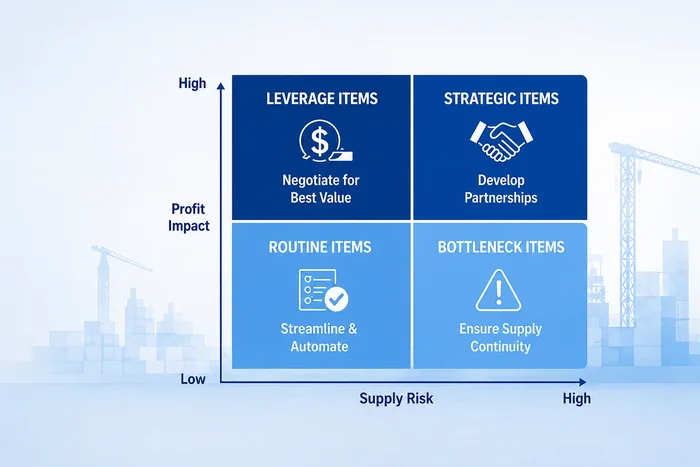
At its core, the Kraljic Matrix is very simple. It maps your spend across two dimensions. First is business impact, which reflects how much a category affects your cost, margins, or operations.
Second is supply risk, which reflects how difficult or uncertain it is to source that category.
Based on these two factors, every category falls into one of four groups.
- Routine items are low impact and low risk. These should be simplified and automated.
- Leverage items are high impact and low risk. These are ideal for strong negotiation and competitive sourcing.
- Bottleneck items are low impact but high risk. These require careful supply planning.
- Strategic items are high impact and high risk. These need long-term supplier relationships and deeper engagement.
The real value of the matrix comes when you start using it to guide decisions.
- Which suppliers need long term partnerships
- Where should you push for aggressive negotiation
- Which categories carry supply risk that can disrupt your business
In practice, most teams either overcomplicate the model or treat it as a one time exercise. Both approaches limit its value. Used well, the Kraljic Matrix helps you focus your effort, manage suppliers better, and approach each category with clarity.
Here is a simple way to apply it in your organization without external support.
Step 1: Start with Your Core Spend Areas
Begin by identifying your key spend categories. The Pareto principle can help you here. Focus on the categories that contribute the most to your overall spend or business impact.
Do not try to cover everything at once. Start with what matters most.
For manufacturing companies, this may include raw materials, packaging, logistics, and maintenance. For construction and EPC, it could be subcontracting, steel, equipment, and project services.
Keep the list manageable. Around 15 to 20 categories is a good starting point.
Step 2: Define Business Impact in Practical Terms
Look at each category and ask a simple question. If I manage this well, how much does it impact my business?
You do not need a detailed financial model. A simple classification is enough. High impact categories directly affect cost of goods, project margins, or delivery timelines. Low impact categories are more indirect.
This step helps you focus on where procurement can create meaningful value.
Step 3: Evaluate Supply Risk Based on Reality
Now assess supply risk for each category.
Ask practical questions. How many suppliers are available. How easy is it to switch. Are there long lead times. Is the market stable. Keep this simple. High risk or low risk is enough to begin with. Your team’s experience is often more valuable than complex analysis.
Step 4: Place Each Category in the Kraljic Matrix
Map each category into one of the four quadrants.
- Non critical items have low impact and low risk
- Leverage items have high impact and low risk
- Bottleneck items have low impact and high risk
- Strategic items have high impact and high risk
At this stage, patterns will start to emerge. Some categories will clearly need more attention than others.
Step 5: Validate with Your Team and Stakeholders
Before finalizing the matrix, review it with stakeholders such as finance, operations, and project teams.
Procurement may see a category one way, while operations may see it differently. These discussions improve accuracy and build alignment. The matrix should reflect business reality, not just procurement perspective.
Step 6: Keep It Simple and Actionable
A common mistake is adding too much complexity. Detailed scoring models and weightages often slow things down. In most mid sized organizations, simplicity works better.
Classify clearly. High or low impact. High or low risk. Clear categories. That is enough to drive better decisions.
The goal is clarity, not perfection.
Step 7: Use the Matrix as a Working Tool
The Kraljic Matrix should not sit in a slide deck. Use it in your daily work. Bring it into sourcing discussions. Use it to decide where to spend time and effort.
For example, strategic categories need more focus on supplier relationships and long term planning. Leverage categories need strong competitive sourcing. When used this way, the matrix becomes part of how your team thinks and operates.
Step 8: Review and Update Regularly
Your business environment keeps changing. Suppliers, markets, and demand all evolve. Review your matrix at least twice a year or when there is a major change. A category that was low risk earlier can quickly become high risk.
Keeping it updated ensures your decisions stay relevant.
A Simple Way to Make This Work Consistently
Most teams understand the framework but struggle to apply it consistently. The challenge is not knowledge – it is execution.
Once you and your team begin using it systematically, the results follow. You will see measurable cost reductions, a more resilient and de-risked supply chain, and stronger, more strategic supplier relationships.
At procurEngine, we have seen procurement teams use simple digital workflows to map categories, track changes, and align sourcing strategies – without relying on heavy or complex systems. It adds structure without adding complexity. More importantly, it makes the process transparent and repeatable.
If you are finding it difficult to get started or need guidance, feel free to reach out at hello@agileapt.com or visit us at procurEngine.
Questions about this article.
What are the two dimensions of the Kraljic Matrix?
How is the Kraljic Matrix different from basic ABC or Pareto classification?
How often should the matrix be reviewed?
What is the most common mistake teams make with the framework?
About the Author
Anupam Aggrwal has spent more than 25 years handling negotiations and helping organizations improve procurement performance through process transformation, digitalization, and strategic sourcing. He also gives guest lectures to supply chain students at Mays Business School at Texas A&M University and the Eli Broad Graduate School of Management at Michigan State University.