
Why Most Mid-Sized US Companies Still Buy Through Emails and Spreadsheets - Even After Spending Millions on ERP
By Anupam Aggrwal · 26 May 2026
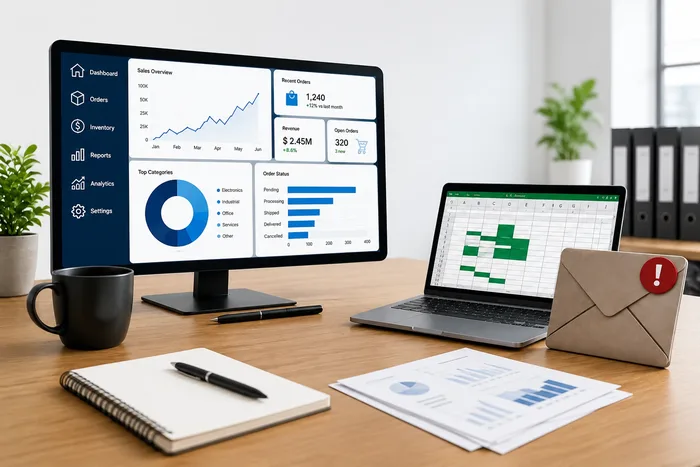
A procurement director approves a $4M ERP program. Six months later, buyers are still emailing suppliers, tracking comparisons in Spreadsheets, and chasing status updates manually.
The ERP became the archive. Email remained the operating system.
I was not surprised. I have seen this exact story play out in dozens of mid-sized companies across the US. Different industries, different ERP systems, same outcome.
The question worth asking is not why procurement teams are ignoring the ERP. The real question is why the ERP is not solving the problem it was supposed to.
The Gap Nobody Talks About in the Boardroom
When a company buys an ERP, it is usually solving for finance, inventory, and manufacturing. Procurement often gets pulled along as an afterthought. The purchase order module gets configured. A few approval workflows go in. And leadership assumes procurement is now “covered.”
What actually happens is something quite different.
The ERP handles the tail end of the buying process. It captures the purchase order once a decision is already made. But everything that happens before the PO, the category strategy, the supplier shortlisting, the RFQ, the negotiation, the comparison, the approval of the right vendor at the right price, that entire process continues to live in email threads and spreadsheet files.
This is not a technology failure. It is a design failure.
ERPs were built for transactional record-keeping, not for active sourcing and procurement decision-making.
Why Email and Spreadsheets Are So Hard to Kill
I want to be honest about something. Email and Spreadsheet are not bad tools. They are extraordinarily flexible, universally understood, and require zero training. When a buyer needs to send a quote request to five suppliers and compare the responses, Excel genuinely works. It is fast, it is familiar, and it gets the job done.
That is exactly the problem.
Because they work well enough in the short term, no one feels enough urgency to change. The pain is diffuse. It shows up as slow cycle times, missed savings, supplier favoritism, compliance gaps, and decisions made without data. But none of these show up cleanly on a dashboard. They are felt, not measured.
Meanwhile, the ERP implementation has consumed the budget and the change management bandwidth. No one is going back to leadership and saying, “We still need to solve procurement.”
What This Actually Costs You
Let me put some texture on the real cost of this gap, because it is easy to underestimate.
When buying happens through email, there is no structured way to enforce competitive sourcing. A buyer who has worked with the same vendor for three years will naturally default to them, not out of bad intent, but out of habit and convenience. Without a structured RFQ process, that habit goes unchallenged. The savings opportunity from opening competition never gets captured.
When comparison happens in a spreadsheet, the person who builds the sheet controls the outcome. The criteria, the weightings, the way the data is displayed, all of it reflects one person’s judgment. There is no audit trail, no standardization, and no way for a manager to know if the comparison was rigorous or rushed.
When approvals happen through email, the chain breaks. Emails get missed. People approve things they did not fully read. Or they delay because they are waiting on more information that no one sent. Cycle times stretch. Suppliers follow up. Relationships get strained.
And when all of this data lives in individual inboxes and local folders, it disappears the moment someone leaves the company. The institutional memory of every deal, every negotiation, every supplier conversation, gone.
The Three Real Reasons This Persists
I have thought a lot about why this pattern is so sticky. In my experience, it comes down to three things.
The first is that procurement is under-resourced for transformation. Mid-sized companies typically do not have a dedicated procurement technology team. The IT budget went to ERP. The change management energy went to ERP. By the time the ERP goes live, everyone is exhausted. Procurement digitization gets pushed to “next year” and stays there.
The second is that the ERP vendor over-promised and under-delivered on procurement. Every ERP sales pitch includes a procurement module. What gets deployed in practice is usually a basic PO creation tool with limited sourcing capability. By the time the company realizes what they have, the contract is signed and the project is live.
The third is that procurement leaders often lack the language to make the business case. They know the process is broken. They feel it every day. But they cannot always translate that pain into dollars that a CFO will act on. If you are in this situation, my earlier post on Cost Center to Strategic Asset: Building Procurement Credibility walks through exactly how to build that case in language finance will respect.
What a Better Model Looks Like
Here is something I want to be direct about. The answer is not to rip out the ERP. The ERP is doing its job, just not the procurement job.
The right model is a purpose-built procurement layer that sits alongside the ERP and handles everything that happens before the purchase order is raised. Think of it as the front end of procurement: structured RFQ workflows, supplier comparison, negotiation tracking, and approval logic. The PO still flows into the ERP. Finance still sees the transaction. Nothing changes for accounting.
What changes is that buying decisions are now structured, auditable, and data-driven.
This is not a theoretical concept. It is what procurement organizations in large companies have built over the past decade. The gap is that mid-sized companies have not had access to tools designed for their scale and complexity. The options were either a full enterprise suite with a multi-year implementation or a manual process held together with email.
That gap is exactly what procurEngine is designed to close.
How Category Strategy Connects to This Problem
One thing I have noticed is that companies which structure their buying by category have a much easier time moving away from email and spreadsheet. When procurement knows which spend categories need competitive sourcing, which need relationship management, and which can be handled through standing agreements, the buying process becomes more predictable. And predictable processes are much easier to digitize.
If you have not done this exercise yet, my post on How to Transform Your Supplier Negotiation Strategy Using the Kraljic Matrix is a good place to start. It walks through how to classify your spend in a way that directly drives better sourcing decisions.
For categories where you have strong negotiating leverage, leaving the process in email is particularly costly. If you want to understand how to fully use that leverage before it slips through informal channels, the post on Negotiating with Leverage Suppliers: Maximize Savings Without Overplaying Your Hand covers the strategy in detail.
What Mid-Sized US Companies Should Do Now
The good news is that you do not need to replace your ERP, redesign your processes, or put your team through another change management cycle. That is not the answer and, honestly, it is not a realistic ask for a mid-sized company that has already been through one major implementation.
What you need is a tightly integrated S2P platform that sits alongside your ERP, connects to it cleanly, and handles everything the ERP was never designed to do. The ERP stays exactly as it is. Finance keeps working the same way. IT does not need to run a parallel project. The integration is the point. Not a replacement, not a workaround, but a purposeful layer that fills the gap between an email thread and a purchase order.
The first and most important shift this creates is that all the data that has been living in inboxes and spreadsheets now lives on a platform. Supplier contacts, past quotes, negotiation history, comparison sheets, approval conversations, all of it moves into a single structured environment. This is not just about convenience. It is about institutional memory. When a buyer leaves or a category changes hands, the knowledge does not walk out the door with them. It stays, organized, searchable, and ready to use.
Supplier qualification and selection also become fundamentally more robust. Right now, in most mid-sized companies, the approved vendor list is a spreadsheet that someone updates when they remember to. New suppliers get added based on a phone call or a referral. There is no structured onboarding, no documentation of capability or compliance, and no consistent way to evaluate one supplier against another. A tightly integrated procurement layer changes that. Qualification becomes a defined process. Suppliers go through it. The output is a verified, documented list that procurement can rely on and leadership can audit.
Approvals are where the daily frustration really lives, and this is where the integration pays off most visibly. When an approval request is linked to the underlying RFQ, the quote comparison, the supplier record, and the budget line all in one place, the approver does not need to chase context across five email threads. They see everything they need to make a decision. The linkage is complete. The audit trail is automatic. And cycle times drop, not because people are working faster, but because the friction of information-gathering is gone.
This is the same approach I have seen work across industries, from industrial manufacturing to professional services to logistics and distribution. The context changes but the principle does not. You do not need more complexity. You need structure layered cleanly on top of what already exists, with the simplicity to get teams to actually use it, the flexibility to fit your categories and your approval hierarchy, and the security to give leadership confidence that buying decisions are being made the right way.
How procurEngine Helps
procurEngine is designed specifically for mid-sized companies that have outgrown email and spreadsheet but do not need the complexity of an enterprise procurement suite.
We bring structure to everything that happens from PR to PO: supplier shortlisting, RFQ creation and distribution, bid comparison, negotiation tracking, and approval workflows. The purchase order still flows into your ERP. Your finance team does not need to change a thing. What changes is that your procurement team now has a structured, auditable process. Every sourcing decision is documented. Every comparison is standardized. Every approval is traceable.
procurEngine adoption is simple and quick. No multi-year implementation. No separate IT project. It is AI powered. Just a cleaner way to buy.
To see how it works, reach out to us at hello@agileapt.com or visit us at procurengine.ai.
Questions about this article.
Why do procurement teams keep using email and spreadsheet even when an ERP is available?
Does this mean the ERP implementation was wasted?
What is the actual cost of buying through email?
How do mid-sized companies make the business case for procurement digitization?
Can a purpose-built procurement tool coexist with an existing ERP?
Where should a company start if it wants to move away from email-based buying?
About the Author
Anupam Aggrwal has spent more than 25 years handling negotiations and helping organizations improve procurement performance through process transformation, digitalization, and strategic sourcing. He also gives guest lectures to supply chain students at Mays Business School at Texas A&M University and the Eli Broad Graduate School of Management at Michigan State University.