
How Suppliers Quietly Gain Negotiation Power Over Buyers?
By Anupam Aggrwal · 6 May 2026
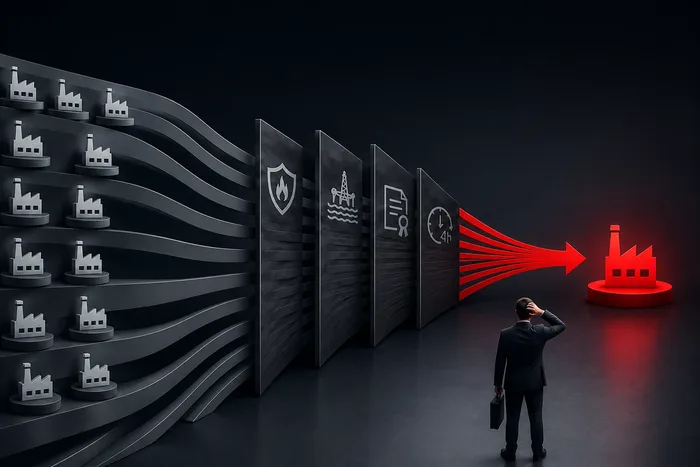
Have you ever tried to buy something that looked completely standard, only to discover that just one supplier could actually meet your requirements?
Many procurement teams believe they still control the negotiation until the day they realize switching suppliers is no longer commercially realistic.
Think about power cables - a field where I spend close to 20 years. As commodity as it gets. Dozens of manufacturers. Multiple distributors. Plenty of competition. On paper, a textbook leverage category.
But then you look at the actual specification sitting in your inbox.
The cable needs to meet a specific fire retardancy certification that only two manufacturers in the country hold. It needs to have been used in a minimum of five years of continuous offshore deployment, which rules out another three. The conductor material needs to meet a proprietary industry standard that your plant team insists is non-negotiable. And the supplier needs to provide a dedicated service engineer on-site within four hours of a fault call, which takes out everyone except one player who happens to have a local depot nearby.
Suddenly your leverage category has one qualified supplier. Prices are firm. Timelines are extremely tight. And you are sitting across the table with almost no power. One supplier gives a notional discount, you have no other option but to jump at it.
Welcome to the real world. You have just got manipulated!
And somehow, nobody in your organization can quite explain how the specification got to this point.
Signs a Supplier May Already Have More Power Than You Think
- engineering rejects alternatives immediately
- supplier pricing is rarely benchmarked
- switching timelines are unclear
- operational teams resist supplier changes
- negotiations focus on relationship preservation rather than commercial leverage
First, a Quick Recap of the Landscape
If you have been following this blog, you already know how the Kraljic Matrix works. We have covered it in detail, including how to classify your spend categories using the Kraljic Matrix, how to negotiate effectively with leverage suppliers, and what it takes to manage a truly strategic supplier relationship.
In that framework, leverage suppliers sit in the high-impact, low-risk quadrant. Multiple capable players. A good competitive market. Buyers hold the power. Smart procurement teams run competitive sourcing events, use e-Auctions, and push hard on price and terms.
That is exactly the kind of situation a smart supplier wants to escape.
Because sitting in the leverage quadrant means price pressure, thin margins, and constant competition. No supplier worth their salt wants to stay there permanently. They want to move up and to the right on that matrix. They want to become strategic. And many of them are very, very good at making that happen.
When I Was a Salesperson
Early in my sales career, I was selling industrial equipment into mid-sized manufacturers. We were one of five qualified suppliers. Our pricing was competitive. Our product was solid, though not dramatically different from the others.
We were leverage. And we knew it.
So we started working the playbook. Not with any malicious intent, I should add. In sales, this is just called good strategy. But when you see it from the procurement side, it looks quite different.
Similarly, A fabricated component initially sourced from three suppliers gradually became dependent on one supplier after repeated engineering customizations and tooling changes. Five years later, switching suppliers required six months of qualification work.
A supplier initially selected because of faster implementation gradually became deeply integrated into production workflows, custom specifications, and quality approvals. Three years later, replacing the supplier required engineering redesign, customer requalification, and operational retraining.
Here is what you, as a procurement professional, need to watch for.
Move 1: Tighten the Qualification Gate
The first thing a smart leverage supplier does is get close to the users, not the buyers. In most organizations, the technical teams, plant heads, and project engineers define what gets specified. Procurement comes in later.
And that is the opening. We would spend time with the user team. Understand their pain points. Help them articulate what they actually needed. And then, quietly, help them define the requirements in a way that happened to favor our product.
Certifications that only we held. Temperature ratings that only our product met. A testing protocol that was designed, sometimes quite genuinely, around our product’s architecture.
Before the RFQ even landed on the procurement desk, the competitive field had already narrowed. Two or three of the five original suppliers could not qualify. Not because they were worse. But because the gate had been moved.
As a buyer, if you are inheriting a specification you did not design, question it. Ask why each requirement exists. Who wrote it and when. Whether alternate materials or methods have been evaluated. Many seemingly technical specifications are actually commercial decisions in disguise.
Move 2: Add Features That Look Attractive but Solve Nothing
This one is subtler. And honestly, it worked brilliantly when I was on the sales side.
We would identify a feature, a capability, an add-on, that was genuinely nice to have. Something the user team would get excited about. An integrated monitoring dashboard. A predictive maintenance alert. An extended warranty module. Things that sounded like value.
These features rarely addressed the core need. But they created a perception of a superior offering.
More importantly, they created a comparison problem. When procurement went to evaluate proposals, our offering and the competitor’s were suddenly not the same product anymore. Apples to oranges. And once you lose the apples-to-apples comparison, competitive pricing pressure weakens significantly.
The buyer starts asking: can the other supplier offer this? No. Can we ask them to match it? Not really, they would need six months to build it. So we are back to sole-source conversations.
Watch for this. When a supplier’s offering includes features that were not in your original specification, ask a simple question. Who asked for this? If the answer is the user team and not your procurement function, you need to find out when and how that conversation happened.
Move 3: Package the Deal to Blur the Lines
The next step in the playbook is aggregation. Bundle the product with services, with additional support, with annual maintenance contracts, with upgrades. Suddenly what was a transactional supply relationship has become an integrated partnership.
And here is the challenge. Each individual element of the bundle may be priced reasonably. But the aggregate locks you in. Switching the product now means switching the service provider. Switching the service provider means retraining staff. Retraining staff means downtime.
The total cost of switching quietly becomes enormous, even though no single line item looks alarming.
We did exactly this with one of our key accounts. Once the maintenance contract was signed and our technicians were embedded in the plant, the conversation shifted entirely. It was no longer about price. It was about continuity and risk.
Procurement teams need to evaluate the total cost of the bundle, not just the headline price. And more importantly, they need to evaluate exit costs at the time of entry. Before you sign, ask what it takes to walk away in year two or three. This is closely tied to the concept of BATNA, your Best Alternative to a Negotiated Agreement. We have covered this in detail in our blog on BATNA in Procurement: The Building Block That Decides Who Has the Power at the Table. If you have no credible alternative at the point of signing, you have already given away your leverage for the life of the contract.
Move 4: Co-Develop and Over-Communicate the Innovation
This is the one I am most familiar with, because I lived it.
At one point in my sales career, we partnered with a leading power utility to co-develop a product enhancement. The improvement was real but marginal. Technically, it moved the needle by perhaps 8 to 10 percent. Not a revolution.
But we marketed it as one.
White papers. Technical seminars. Press coverage in trade publications. Invitations to plant visits. We over-communicated at every level, with user teams, technical committees, and industry bodies. The product became the reference point in the category. Competitor products were being compared to ours, not the other way around.
And once you become the reference, you are no longer in the leverage quadrant. You are strategic.
The lesson for procurement is this. Innovation claims deserve scrutiny. Ask for independent validation. Ask what the actual performance delta is. Ask whether a competitor product with the same underlying capability exists under a different name. A well-marketed marginal improvement is still a marginal improvement. Your job is to see through the packaging.
Most supplier leverage does not emerge suddenly. It develops gradually through operational convenience, customization, and reduced switching flexibility.
Move 5: Embed People, Build Relationships, Create Dependency
The final move is the most human one. And perhaps the most effective.
Relationships matter in B2B. I genuinely believe that. Suppliers who invest in the success of their customers, who show up when things go wrong, who go beyond the contract, those suppliers deserve recognition and long-term partnership.
But there is a version of relationship-building that is really about creating dependency. When the supplier’s application engineer becomes the go-to expert inside your plant. When the sales rep has a standing lunch with your plant head every month. When your technical team has been to the supplier’s facility for training three times this year and considers their counterparts trusted colleagues.
At some point, switching becomes socially and organizationally difficult, not just technically or commercially. Your own people start advocating for the supplier, sometimes without fully realizing they are doing it.
Procurement needs to be aware of the depth of these relationships without breaking them. Strong supplier relationships are genuinely valuable. We have talked about that in detail in our piece on negotiating with strategic suppliers. The question is whether the relationship exists because the supplier has earned it through consistent performance, or because they have engineered it through access and familiarity.
The distinction matters enormously when a contract comes up for renewal. That requires structured visibility into sourcing history, supplier dependency, qualification complexity, and negotiation patterns “The hardest part is not negotiating with powerful suppliers. The hardest part is recognizing when leverage has already shifted”
So What Does This Mean for Procurement?
Let me be clear about something before I go further. None of this is to say that suppliers are acting in bad faith. Most are not. They are doing exactly what good salespeople are trained to do: understand the customer deeply, create differentiated value, and build reasons to stay. That is smart business. I did it myself for 15 years and I am proud of it.
But procurement’s job is to see through the strategy without dismantling the relationship. These are not the same thing. You can respect a supplier’s commercial intent and still protect your organization’s sourcing freedom. In fact, the best procurement professionals I have worked with do exactly that. They keep the relationship warm and the strategy sharp.
Here is what that looks like in practice.
Hidden Supplier Leverage Is Rarely Visible Early
Most procurement teams do not lose negotiation power in one dramatic moment. It happens gradually.
A supplier starts as one of many approved options. Then comes customization. Then operational familiarity. Then engineering preference. Over time, the cost of switching quietly becomes larger than the cost of accepting higher prices, longer lead times, or lower flexibility.
By the time the organization realizes the supplier has become “strategic,” the leverage has already shifted. The challenge is not identifying supplier dependency after it becomes obvious.
The real challenge is recognizing it early - while alternatives still exist.
A Simple Question Procurement Leaders Should Ask
“Which of our suppliers would be hardest to replace in the next 90 days - and do we know exactly why?”
Most organizations do not have a structured answer. Not because procurement teams lack capability, but because dependency builds across:
- sourcing history
- engineering decisions
- operational habits
- qualification complexity
- stakeholder preferences
That information rarely exists in one place.
Download: Supplier Negotiation Power Assessment Framework
To help procurement leaders evaluate hidden supplier dependency risks, we created a simple assessment framework that helps teams identify:
- suppliers gaining silent leverage
- operational dependency risks
- engineering lock-ins
- weak competitive positions
- categories where switching has become unrealistic
The framework includes:
- dependency scoring model
- supplier leverage indicators
- switching-risk evaluation
- negotiation exposure assessment
- action-priority matrix
Final Thought
Supplier leverage rarely appears suddenly. It accumulates quietly through every unmanaged customization, every operational shortcut, and every negotiation where the buyer no longer has a credible alternative.
The earlier procurement teams recognize this shift, the more strategic options they still have.
If you would like the Supplier Negotiation Power Assessment Framework, reach out to us through procurEngine.
Should you face any difficulty in understanding that, please feel free to reach us at hello@agileapt.com or visit procurEngine at procurengine.ai.
Anupam Aggrwal spent the first 15 years of his career in B2B sales and marketing before moving to the procurement and consulting world. That shift in perspective informs everything he writes and builds. You can reach the team at hello@agileapt.com or visit procurEngine at procurengine.ai.
People Also Ask
How do suppliers increase their negotiating power over time?
Through specification influence, feature differentiation, bundled contracts, innovation marketing, and relationship depth with user teams. Each move individually may look reasonable. Taken together, they systematically reduce the buyer’s sourcing options.
What is the difference between a leverage supplier and a strategic supplier?
Leverage suppliers operate in competitive markets where buyers hold the power. Strategic suppliers are critical to operations and hard to replace, which shifts power toward the supplier. The Kraljic Matrix maps both positions clearly.
How can procurement prevent supplier lock-in?
By maintaining specification ownership, evaluating total cost of ownership upfront, benchmarking regularly, building a credible BATNA before signing, and keeping the competitive field open even during incumbent relationships.
What is the Kraljic Matrix and how does it help identify supplier positioning?
It is a two-axis framework that classifies spend categories based on business impact and supply risk. Used actively and updated regularly, it helps procurement identify when a supplier’s position has changed and whether that change reflects market reality or deliberate commercial moves.
How do you negotiate with a supplier who has already become strategic?
Carefully and strategically. The goal is to protect value without damaging a relationship that may be genuinely important. We cover this in depth in our post on negotiating with strategic suppliers.
Questions about this article.
What does it mean for a supplier to move from leverage to strategic?
How can procurement protect itself from specification manipulation?
Is it always bad if a supplier becomes strategic?
How does bundling affect total cost of ownership?
What is the role of relationships in supplier strategy?
What is BATNA and why does it matter here?
Can you reverse a supplier’s move from leverage to strategic?
About the Author
Anupam Aggrwal has spent more than 25 years handling negotiations and helping organizations improve procurement performance through process transformation, digitalization, and strategic sourcing. He also gives guest lectures to supply chain students at Mays Business School at Texas A&M University and the Eli Broad Graduate School of Management at Michigan State University.